Showing posts with label Concept Car. Show all posts

Tuesday, August 2, 2011

2014 BMW Sport Cars i8 Concept

2014 BMW Sport Cars i8 Concept
The BMW i8 Concept retains much of the theatre and excitement of the BMW Vision EfficientDynamics concept that first previewed the futuristic sports car design at Frankfurt in 2009, and starred at the 2011 Australian International Motor Show in Melbourne last month. Sometimes it is time to leave the city. Escape the restrictions of everyday life. The BMW i8 is an icon of progress. It combines the energizing performance of a sports car with benchmark efficiency.
2014 BMW Sport Cars i8 Concept
Unlike the Vision concept which utilised a diesel engine, the new 2014 BMW Sport Cars i8 Concept adopting a hybrid setup with an electric motor and a 1.5-liter gasoline unit. The 1.5-litre three-cylinder turbocharged petrol engine produces an astonishing 164kW of power and 300Nm of torque. To give that some perspective, the current BMW 125i is powered by a 3.0-litre inline-six with 160kW of power and 270Nm of torque – double the capacity, double the cylinders, 4kW less power, 30Nm less torque.
The 2014 BMW Sport Cars i8 Concept and the fascinating approach that underpins it embody the vision of a sustainable contemporary sports car brought to life. Its innovative plug-in hybrid concept combines the modified electric drive system from the BMW i3 Concept - fitted over its front axle - wîth a high-performance three-cylinder combustion engine producing 164 kW (220 hp)/300 Nm (221 lb-ft) at the rear.
2014 BMW Sport Cars i8 Concept
The electric motor in the 2014 BMW Sport Cars i8 Concept is a full-capability unit which can also power the car on its own, if required. However, working in tandem allows the two drive systems to display their respective talents to the full, delivering the performance of a sports car but the fuel consumption of a small car.
2014 BMW Sport Cars i8 Concept
Assisting the petrol engine is 96kW/250Nm electric motor, which draws power from a lithium-ion battery. With a combined maximum power output of 260kW and 550Nm, the i8 Concept is capable of accelerating from 0-100km/h in just 4.6 seconds (80-120km/h in 4.0 seconds) and will go on to an electronically limited top speed of 250km/h.
2014 BMW Sport Cars i8 Concept
These impressive features of the German sports car are even greater considering that BMW announced a combined fuel consumption of only 2,7 liters/100 km. In terms of dimensions, the i8 Concept measures 4,6m long, 1,9m wide and 1,2m tall.
2014 BMW Sport Cars i8 Concept
The great power amount offered by the new i8 is also valued by the low total mass of only 1,480 kilograms achieved by using a carbon fibre-reinforced plastic (CFRP) body and an aluminum chassis. The Germans claim that they managed to obtain a 50/50 weight distribution by mounting the engines on each axle, this achievement bringing significant advantages.
2014 BMW Sport Cars i8 Concept
The weight of every component inside the 2014 BMW Sport Cars i8 Concept has been minimised down to the very last detail, allowing the extra weight of the electric drive system and battery to be cancelled out. The 2014 BMW Sport Cars i8 Concept therefore presents the ideal environment in which to sample this very special drive concept on the road. The passengers sit - in typical sports car style - in an extremely low and enclosed position inside the CFRP-constructed Life module (mounted above the Drive module).
2014 BMW Sport Cars i8 Concept
“The sporting character continues into the interior. Boasting a driver-focused environment unmatched by any BMW Group vehicle before it, the 2014 BMW Sport Cars i8 Concept immerses the driver fully in the unique driving experience. The BMW i8 Concept is the sports car for a new generation – pure, emotional and sustainable,” adds BMW.
2014 BMW Sport Cars i8 Concept
Far from just being a performance car, however, the i8 Concept can also be driven in fully electric zero-emissions mode for up to 35km. A full recharge of the battery from a standard power socket takes approximately 105 minutes.
2014 BMW Sport Cars i8 Concept
The navigation system also calculates the best way to manage energy consumption for the trip to ensure that it operates at peak performance and optimal efficiency when required. Under the European driving cycle, the 2014 BMW Sport Cars i8 Concept uses fuel at a rate of just 2.7 litres/100km combined, making it one of the most fuel efficient internal combustion engined automobiles in history.
A production version of the BMW i8 Concept is expected to go on sale in Australia in 2014 with a predicted price tag of $300,000.
2014 BMW Sport Cars i8 Concept
BMW Sport Cars i8 Concept specifications:
# High performance 3-cylinder petrol engine (164 kW) in rear with i3's electric motor (limited to 96 kW) in front
# Total torque of 550 Nm (300Nm petrol engine + 250 Nm electric motor)
# 3 driving modes - electric, petrol, or both engines at once
# 1,480 kg
# 0-100kph (62mph): 4.6 seconds
# Top speed: 250kph (limited)
# 2.7 L/100km fuel economy
# 35km pure electric range
# 4 seater
# 50:50 distribution
# Market Launch: 2014

Monday, August 1, 2011

Kawasaki Sport Cars ZX-770R Hypercar Concept by Sabino Leerentveld

Kawasaki Sport Cars ZX-770R Hypercar Concept by Sabino Leerentveld
The design Kawasaki Sport Cars ZX-770R Hypercar Concept by Sabino Leerentveld based on Kawasaki bikes to rival the KTM  X-Bow, this is more hypercar level though as it would be 770HP, mid engine layout V6 twin turbo at around 5oo kilos.
Kawasaki Sport Cars ZX-770R Hypercar Concept by Sabino Leerentveld
The Kawasaki Sport Cars ZX-770R Hypercar Concept by Sabino Leerentveld design features a mid-mounted win turbo V6 capable of displacing 770 horses. The two-seater stands in at 1017mm high, 4427mm long and 2073mm wide with a wheelbase of 2710mm.
Kawasaki Sport Cars ZX-770R Hypercar Concept by Sabino Leerentveld
Weighing in at 500 kg, Kawasaki Sport Cars ZX-770R Hypercar Concept by Sabino Leerentveld sits pretty on 19 and 21-inch alloys with flowing curves smoothly overlapping to give it an overall semblance of a water stream galloping past rounded rock in Alpine rapids.
Kawasaki Sport Cars ZX-770R Hypercar Concept by Sabino Leerentveld
Although the designer’s vision was clearly inspired by the stallion-esque design of the iconic superbikes, the hypercar concept appears more fluent without that footnote undermining its crisp lines.
Kawasaki Sport Cars ZX-770R Hypercar Concept by Sabino Leerentveld

Saturday, July 9, 2011

2011 Honda Odyssey Minivan Concept Debut At The Chicago Auto Show

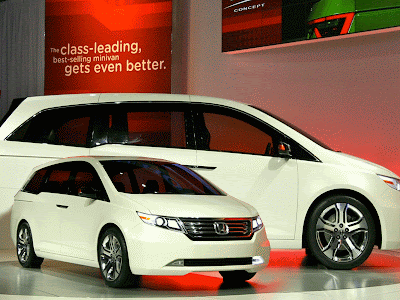
January 26th, 2010 Honda has confirmed that it will show the next generation of its Odyssey minivan at the Chicago Auto Show on February 2010. Honda today gave us the first look at the next-generation of its award-winning Odyssey minivan with the new Honda Odyssey Concept, which is on display at the 2010 Chicago Auto Show, introduces a sleek and distinctive exterior styling direction for the next generation of the industry's best-selling minivan, set to debut this fall, American Honda Motor Co., Inc..
2011 Honda Odyssey Minivan Concept

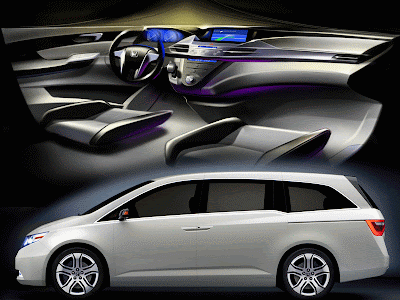
The Odyssey Concept dramatically departs from conventional minivan styling with its low and wide stance, highlighted by a "lightning-bolt" beltline that further distinguishes the vehicle's profile. Compared to the current Odyssey, the Concept's slightly lower roofline (-1.0 inch) and wider stance (+1.4 inch) contribute to a sleeker, stronger and more dynamic presence with improved aerodynamics that help increase fuel economy. Forthcoming improvements to the production Odyssey's interior are designed to further enhance the current model's accommodating space for people and cargo.
2011 Honda Odyssey Minivan Concept

The steeply raked front and rear roof pillars, unique side-glass profile, chamfered roof line, and tapered rear cabin shape combine to create a dynamic and distinctive appearance from any perspective. The lightning-bolt beltline dives toward the rear of the vehicle emphasizing the new Odyssey's sporty appearance while enhancing outward visibility for third-row passengers. Aggressive body-to-wheel proportions reduce the perception of vertical height common to most minivan designs. Fender flares further accent the vehicle's securely planted and stylish persona. The concept vehicle's projector beam headlights, LED taillights and form-fit fog lights further heighten the sophisticated quality of the design.
2011 Honda Odyssey Minivan Concept

Enhanced aerodynamics and advanced powertrain technologies will contribute to the next-generation Odyssey's increased fuel efficiency. The all-new 2011 Odyssey is expected to achieve an EPA-estimated fuel economy rating(1) of 19 city/28 highway miles-per gallon on select models (preliminary estimate determined by Honda).
2011 Honda Odyssey Minivan Concept

Currently in its third generation, the Odyssey's unique array of features, including its superior driving dynamics, 3rd-Row Magic Seat(R) and efficient i-VTEC(TM) V-6 engine with three-mode Variable Cylinder Management(TM) (available) all combine to offer a sophisticated environment with room for up to eight people (seven on Odyssey LX). The Odyssey has been America's best-selling minivan(2) since 2008 and is produced exclusively in Alabama by Honda Manufacturing of Alabama (using domestic and globally sourced parts). Both the concept and production vehicles, along with all development activity for the 2011 Odyssey, are being designed at Honda R&D Americas in Torrance, California, and Raymond, Ohio.
2011 Honda Odyssey Minivan Concept

The Odyssey has won numerous awards and critical acclaim. Recent accolades include the Edmunds.com 2010 "Top Recommended" minivan award, U.S. News and World Report 2010 "Best Minivan for the Money" award, Automotive Lease Guide 2010 "Best Minivan for the Money," the Kelley Blue Book award as one of the ten "Best New Family Vehicles of 2009" and "2009 Best Resale Value Award" in the van category, which recognizes vehicles that are expected to have segment-leading resale value after five years of ownership.
 
2011 Honda Odyssey Minivan Concept

Tuesday, November 23, 2010

Cadillac Sports Cars Aera lightweight Concept Car

Cadillac Sports Cars Aera lightweight Concept Car
This is the Cadillac Aera (Aero + Era) launches Cadillac's philosophy of "Art and Science" into new territory by taking an innovative and stylistic approach to ultra-light weight vehicle design. LOS ANGELES – The Cadillac Aera concept vehicle won the 2010 Los Angeles Auto Show Design Challenge, tying with Smart and besting entries from seven other automakers including Mercedes-Benz, Honda, Nissan, Toyota and Maybach. GM Advanced Design has now won the honor more times than any other design team.
General Motors advanced design California has come up with a concept cars zero-emission vehicle as part of this year’s LA Auto Show Design Challenge. Cadillac Sports Cars Aera lightweight Concept Car is a 1000 lb, 2+2 touring coupe, with a range of 1000 miles before refueling; attributes achieved without compromising size, capacity and safety. With an ability to seat four, the vehicle uses a body structure made from mono-formed 3D lattice that is extremely sturdy.
Cadillac Sports Cars Aera lightweight Concept Car
This marks the third time that the group from General Motors has won this challenge, giving them the most wins out of all automakers that enter. The Cadillac Aera Concept hit on all areas that the judges were looking for and, despite the futuristic styling, still carries some recognizable lines from Cadillacs of today.
Jussi Timonen, lead designer for the project shared: „The Cadillac Sports Cars Aera concept was designed to continue the forward-thinking imagination of Cadillac’s ‘art and science’ philosophy. It’s designed as a small city urban vehicle, but we approached this 2+2 touring coupe very much from the brand’s luxury perspective. Every detail of the Aera was conceived to minimize the vehicle’s environmental impact without sacrificing the style, comfort and attention to detail that are hallmarks of the Cadillac cars brand.”
Cadillac Sports Cars Aera lightweight Concept Car
The Aera is powered by compressed air via a highly efficient Pneumatic Drive System that has a 10,000-psi composite air storage tank with capacity for a 1,000-mile range. Flexible, pressurized air cells in the exterior skin, similar to material developed for the NASA Mars Rover airbags, enhance passive safety and interior comfort. The flexible polymer skin optimizes aerodynamics and functions as an ultra-lightweight alternative to conventional body panels and glass.
Additional technologies include an All-In-One (AIO) wheel system, combining rotary actuator propulsion, steering and suspension functions. A drive by wireless system decreases the mass of electrical components. Vehicle to vehicle communication (V2V) promotes active safety. The Cadillac Aera embodies a stylistic, lightweight, minimalist approach to long distance luxury touring.
Cadillac Sports Cars Aera lightweight Concept Car
The Design Challenge is part of the Design Los Angeles automobile designers’ conference and has evolved into an integral element of the Los Angeles Auto Show. Design Los Angeles connects those working in the design industry with well-known automotive design industry leaders. Los Angeles is home to the world’s largest concentration of manufacturer design studios, representing automakers from North America, Europe and Asia. It is also the home of Art Center College of Design, one of the world’s foremost transportation design institutions where many of today’s leading automotive designers began their careers.

Friday, November 19, 2010

2010 Lotus Sport Cars Elan Concept

2010 Lotus Sport Cars Elan Concept

At Paris Auto Show 2010 Lotus automaker manufacture has display six new models super car sport. One of the six models is the Lotus Elan Concept. 2010 Lotus Elan Concept Cars, a high performance sports car, is the beating heart of the new Lotus line-up and thanks to some clever innovations the Lotus Elan also has everyday usability too.
2010 Lotus Sport Cars Elan Concept
Elan is expected to go to production in summer of 2013 and will be available for purchase in fall of 2013. Like the Evora, the Lotus Elan features 2+2 seating, suggesting that the new Evora may not really have a long life at Lotus. Prices for the production Elan are estimated to start around $118,500 ( £75,000 ).
Lotus Elan Concept Power is provided by a mid-mounted 4.0-liter V6 engine with 450 PS (331 kW / 444 hp) and 465 Nm (343 lb-ft) of toque. It is backed up by a seven-speed DCT transmission, which enables the 1,295 kg (2,855 lb) car to accelerate from 0-100 km/h in 3.5 seconds and hit a top speed of 310 km/h (193 mph). If that fails to attract your attention, perhaps you’ll be interested in the hybrid variant which will have CO2 emissions as low as 199 g/km. With performance specs like that, there's a little double that Elan is supercar.
From a styling perspective, the Elan is built like an athlete with a muscular physique and perfect poise. It’s a thoroughbred, rigid with tension, ambitious and addictive, nothing but best in class will suffice for this car.
It’s not enough to simply provide performance and exceptional looks, innovation is also integral to the Elan’s appeal. In keeping with the rest of the new Lotus range, the Elan features optional hybrid technology with KERS.
2010 Lotus Sport Cars Elan Concept
Dany Bahar, Chief Executive Officer of Group Lotus, said: “If there was ever a car to make you drive the long way home, it’s the Elan. Perfect for both road and track, the Elan not only ticks all the boxes, it creates new ones too.”
“The Elan will convert people to Lotus, I would challenge people not to become addicted to driving it. It will also go a long way towards dispelling the old misconceptions about this class, that in order to have high performance you must sacrifice usability – those days are gone.”
“Once you drive an Elan you won’t look back, it will give you things you didn’t even realise you were missing – that’s the essence of Lotus and the Elan perfectly captures that spirit.”

2010 Lotus Sport Cars Elan Concept

Tuesday, November 16, 2010

Mob Toyota Sports Cars Concept

Mob Toyota Sports Cars Concept
The Mob is the proposal to Toyota Sports Cars Concept. Toyota MOB concept car, was designed by Spanish designer Jorge Marti Vidal. The Mobius strips have been involved into these cars. The Mob Toyota Sports Cars Concept is the work of Spanish designer Jorge Marti Vidal. The concept was developed during his final year of the Masters degree course in automotive design at the Universidad Politecnica de Valencia.
Mob Toyota Sports Cars Concept
The “Toyota MOB” is a cars concept that inspired by the idea of the Mobius strip incorporates unusual bodywork. There are the two films also available to change the interior and the exterior structure of this sports cars.
These two films are also responsible to form the dash board and the seats of the car. The main central area, where the driver is use to be seated, is transparent to feel real sensation of the car racing. With the help of the transparent central area, the driver of the Mob can view the ground closely. The wheels emulate the shapes of the blossoming flowers. The car was made of an organic material “liquid wood,” which is created using the waste product of lignin, left after the manufacture of paper.
The liquid wood is from one of the organic materials that can easily be modified into various shapes. The zero-emission car carries two continuous panels, which weave their way back and forth to form the body and the chassis. Moving on the wheels with built-in motors, the racing car includes an all-electric drivetrain to ensure an in-wheel drive. Measuring 3,643 x 1,787 x 1,063mm (LWH) in dimensions, the electric vehicle tout dynamic eco credentials without compromising the thrill.
To further improve the Toyota MOB’s eco-friendly credentials, the proposed drivetrain is all-electric – with each wheel getting its own dedicated motor. Vidal envisaged the Toyota MOB as a environmentally responsible racing car, but it could just as easily act as a lightweight sports cars. As such the car is fitted with a small cargo area for storing personal items.
Mob Toyota Sports Cars Concept
Adding more to Concept’s green factor is an all electric drivetrain, wherein all the wheels have individual motors to propel the car. Coming to its construction, the car is made of two panels that weave back and forth. The panels not only give this vehicle a perfect shape, but make up everything from the bodywork and chassis, to the seats and dashboard. The designer has envisioned an eco friendly and lightweight race car that makes environment feel happy.
Mob Toyota Sports Cars Concept